
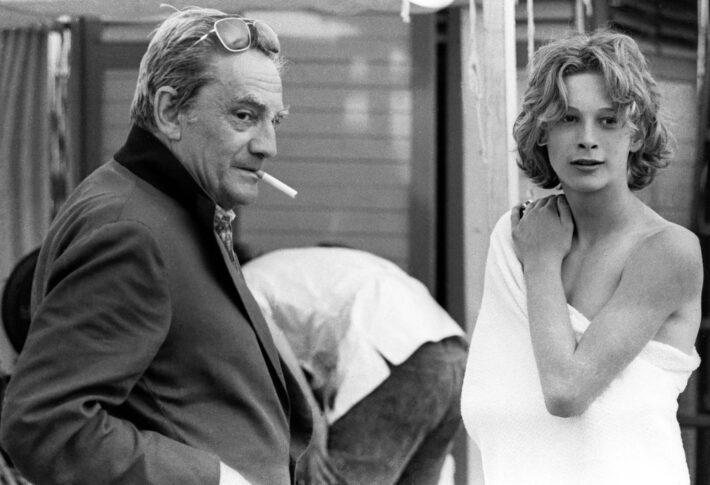
A fascinating and partially disturbing study of beauty, desire, obsession – undeniably sexual. Through Aschenbach’s gaze, the film/movie/cinema requires a single, narrow definition of beauty, one centered upon youthful masculinity, and holds it as an object of desire and worship.
The boy Tadzio embodies timeless ideals of beauty and youth that have been worshipped throughout Western history. He is ethereal beauty, with delicate features, porcelain skin and dazzling blue eyes.
Physical beauty is a source of inspiration and desire, a symbol of life force such as drives all art and human endeavor. Throughout, we participate implicated as Tadzio’s beauty captivates and transforms Aschenbach, inspiring the composer.
We are invited to admire, to desire, to understand captivation.
We are invited to acknowledge sex as impetus.
In the shadow of death, Aschenbach’s desire for Tadzio becomes a quest for transcendence, a search beyond limits of the mortal world. Desire is tinged with sadness – reminding of transience of beauty and inevitability of death.
Death In Venice draws our yet critical awareness to question limitations of desire and dangers of societal norms. Aschenbach’s fixation on Tadzio is destructive, a warning as much as the ‘unhealthy’ and entirely self-destructive is validated as inevitable and as necessary – as the point.
Tadzio is imbued with signification. This exceeds its limited form and raises questions as to the nature of the representation. Representation of beauty as construction / as reflection shaped by the gaze of the beholder – product of the observer / product of the observed.
A curious artifact of its era, such problematic representation is yet compelled in itself of desire to acknowledge constraint – limit of the possible. Arguably, this too is to acknowledge era – our own.